Save $1,000,000 in 10 Years: Calculator-First Plan
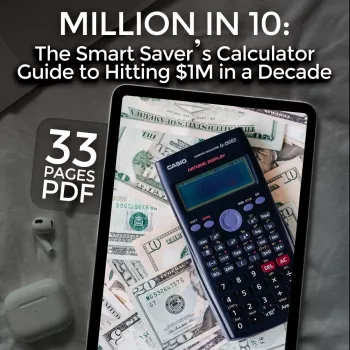
Million in 10: a calculator-first way to make a $1,000,000 goal actionable
Big goals get easier when you can translate them into clean numbers and repeatable steps. Our team created Million in 10: The Smart Saver’s Calculator Guide to Hitting $1M in a Decade for the saver who wants a realistic path you can actually run month after month: choose assumptions, calculate a target contribution, build a “contribution-first” spending plan, and keep the plan alive with checkpoints.
This isn’t about pretending a certain return is guaranteed. It’s about giving you a sturdy workflow so you can adjust as income, expenses, and markets change—without guessing what to do next.
What this calculator guide helps you do (in plain terms)
- Turn a $1,000,000 goal into a monthly savings target with adjustable assumptions.
- Compare multiple paths (higher savings/lower returns vs. lower savings/higher returns) without assuming any outcome is certain.
- Build a spending plan that protects contributions first, then organizes everything else.
- Track progress with milestone checkpoints so your plan stays usable when life changes.
- Use a repeatable routine: update monthly, run scenarios quarterly, and do a bigger reset annually.
Start with the inputs that actually move the outcome
A decade goal can feel intimidating until you narrow it down to the few variables that truly drive results. When you run the calculator, focus on:
- Current starting point: include the accounts that apply to you (cash savings, brokerage, retirement).
- Monthly contribution: the amount you can automate and protect from lifestyle creep.
- Time horizon: 10 years is the headline, but it’s smart to test 7–15 years to see tradeoffs.
- Expected rate of return: use a conservative baseline, then stress-test lower and higher cases.
- Fees and friction: account fees, fund expense ratios, and the reality that contributions may vary.
- Inflation awareness: $1,000,000 is a number; purchasing power changes, so revisit the target annually.
If you want a neutral place to sanity-check compounding math, the SEC’s tool is a solid reference: Investor.gov Compound Interest Calculator.
A practical budget structure that supports a million-dollar goal
The biggest difference between “I’ll save more” and “I saved more” is a structure that makes contributions the default. In our team’s planning layout, you’ll build your budget in this order:
- Contribution-first line items: savings/investing gets scheduled like a bill.
- Fixed commitments vs. flexible spending: separate housing/insurance/debt minimums from food, fun, and subscriptions.
- A one-time “leak list”: recurring charges and impulse categories that quietly block contributions.
- A buffer line: a small cushion reduces the odds you’ll raid accounts when surprises happen.
- True-expense planning: map annual costs (car repairs, gifts, travel, medical deductibles) so “big months” don’t break the plan.
For straightforward budgeting fundamentals, the CFPB has a helpful overview you can compare your approach to: CFPB budgeting and cash flow basics.
Example scenario table (for planning, not promises)
Scenarios help you see which lever matters most in your situation: savings rate, timeline, or return assumptions. Use the table below as a planning lens—then plug your own numbers into your calculator workflow and run a “lower-than-expected” case on purpose.
| Starting Balance | Monthly Contribution | Assumed Annual Return | Time Horizon | What This Scenario Teaches |
|---|---|---|---|---|
| $0 | $6,000 | 5% | 10 years | High savings can compensate for modest returns; requires strong income control. |
| $25,000 | $4,500 | 6% | 10 years | A head start reduces monthly pressure; consistency still does the heavy lifting. |
| $100,000 | $2,800 | 7% | 10 years | Larger starting balances lower the required monthly contribution—but market risk matters. |
| $0 | $3,500 | 7% | 12–13 years | Extending the timeline can make the monthly target more realistic. |
| $50,000 | $2,500 | 4% | 15 years | Conservative returns often mean time must increase; useful for cautious planning. |
How to use the calculator workflow month after month
If retirement accounts are part of your plan, it also helps to stay current on annual limits; the IRS overview is the most reliable source: IRS retirement plan and IRA contribution FAQs.
Common planning mistakes this guide is built to prevent
Who this eBook fits best (and how to get the most from it)
Optional add-ons our customers use to support the routine
- Million in 10: The Smart Saver’s Calculator Guide to Hitting $1M in a Decade (the core planner + calculator workflow).
- Muscle Relaxation Toolkit for Total Tension Relief – 3-in-1 Bundle if you want a stress-reduction routine that pairs well with a monthly money meeting habit.
- Vintage Resin Vase as a simple “reward item” some customers use for milestone moments (first $10k, $50k, $100k) without breaking the plan.
Next step: set a first-month target that’s sustainable
FAQ
Is reaching $1,000,000 in 10 years realistic?
It depends on three levers: your starting balance, how much you can contribute each month, and the return assumptions you use for planning. Scenario planning is key because it shows what happens if returns come in lower than hoped, and it makes it clear whether extending the timeline or increasing income is the more realistic adjustment.
What return rate should be used in the calculator?
Use a conservative baseline first, then run at least one lower and one higher scenario to understand your range of outcomes. Returns are never guaranteed, and your chosen assumption should reflect fees, taxes, and your personal risk tolerance.
Should debt payoff come before investing toward the million goal?
A balanced approach usually works best: stay current on minimum payments, prioritize high-interest debt, and keep an emergency fund so you don’t backslide. Then compare side-by-side scenarios—one that accelerates debt payoff and one that invests consistently—to see which timeline and monthly cash flow fit your life.















Leave a comment