Round LED Bathroom Mirror: Lighting and Defogging Guide
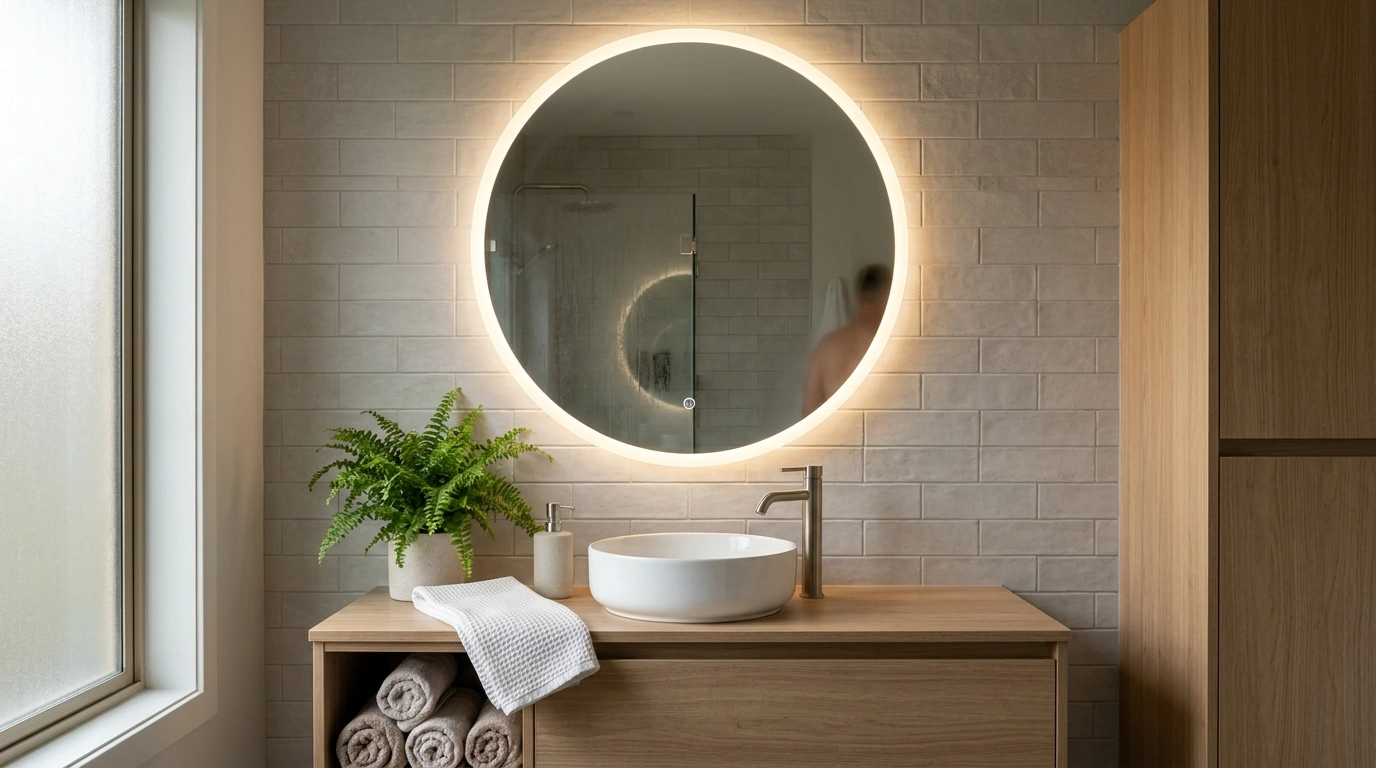
A bathroom mirror does more than reflect the room. It supports the first routines of the morning and the last ones at night. Our Round Smart LED Bathroom Mirror with 3-Color Adjustable Backlight & Defogging Feature brings together a soft, rounded shape, adaptable lighting, and a feature designed to help when steam builds up. The best way to decide whether it belongs above your sink is to consider the whole vanity area, not just the mirror on its own. For more guidance, see LED Bathroom Mirror India: Backlit vs Front-Lit, Colour ….
Why the Round Shape Works
Bathrooms often have a lot of straight lines: vanity edges, tile, cabinets, and door frames. A round mirror introduces a different shape without requiring you to change those larger elements. Above a compact vanity, it can make the area feel less rigid while still giving the sink a clear focal point. For further reading, see Smart Mirror.
Look at the wall around the mirror as well as the space it will occupy. Nearby sconces, shelves, and tall cabinets need breathing room. The mirror should also sit comfortably above the faucet and backsplash, where you can use its reflection without feeling crowded by the sink. A round shape is not automatically right for every bathroom; your vanity width, surrounding fixtures, and usual standing position matter more than any design rule.
| Consideration | What to check | Why it matters |
|---|---|---|
| Vanity width | Compare the mirror’s listed dimensions with the vanity and available wall space. | A balanced fit looks intentional and leaves room for nearby fixtures. |
| Mounting height | Account for users’ heights, the faucet, and the backsplash. | The reflection should be useful without crowding the sink area. |
| Nearby lighting | Note existing sconces and ceiling lights. | Backlighting works best as part of a layered lighting plan. |
Make the Most of Three Lighting Colors
The mirror’s three-color adjustable backlight gives you options as your routine changes. You might prefer one available color while getting ready in the morning and another when winding down at night. In a shared bathroom, each person can choose the light they prefer without changing the room’s permanent fixtures.
Try each color in your bathroom rather than assuming a setting will look the same as it does elsewhere. Daylight, wall color, and other fixtures all affect how light appears. Backlighting can add illumination and atmosphere, but tasks that call for an evenly lit face may still benefit from front-facing or side lighting. The U.S. Department of Energy’s guide to lighting choices offers useful background as you consider the room’s broader lighting plan.
Think, too, about when you actually use the sink. If your bathroom has strong daylight in the morning but relies on a ceiling fixture after dark, judge the mirror’s backlight in both conditions. That gives you a better sense of what it adds—and whether another light source is still needed.
A Defogging Feature for Steamy Mornings
A clouded mirror can interrupt an otherwise quick routine after a hot shower. The defogging feature is intended to help keep the reflection usable when steam builds up, so you can return to the sink with less waiting or wiping.
It is a visibility feature, not a substitute for managing moisture throughout the bathroom. Shower length, room size, and humidity can affect conditions around the mirror, so follow the supplied operating instructions and avoid expecting a completely clear surface in every situation. An appropriately used exhaust fan helps remove humid air from the room; wiping away standing water and maintaining surrounding surfaces matter, too.
Plan the Space Before Installation
Before ordering or scheduling installation, confirm the mirror’s current listed dimensions, mounting requirements, power requirements, and included hardware. Measure the wall rather than relying on the vanity width alone, and mark a comfortable viewing position for the people who use the sink. Then check for conflicts with the faucet, backsplash, shelving, and existing lights.
Pay particular attention to where power is available. Do not assume a wiring method or control type: use the supplied instructions and keep the installation consistent with local electrical requirements. A qualified electrician can help when bathroom wiring is involved. For additional bathroom electrical-safety context, see the Electrical Safety Foundation International’s information on ground-fault circuit interrupters.
Our simplest decision test is this: Can the mirror fit the wall, provide a comfortable view, and work alongside the lighting and ventilation you already have? If one part of that answer is uncertain, resolve it before installation day. A few measurements and a review of the room’s existing connections are easier than finding out too late that a fixture is in the way.
Bring the Routine Together
Our round smart LED mirror is an option when you want a rounded focal point, adaptable backlighting, and defogging in one bathroom mirror. Visit the product page for current dimensions, installation details, availability, and purchasing information before deciding. If you are also arranging nearby decor, our Vintage Resin Vase is another piece to consider for a suitable spot outside the sink’s splash area; check its dimensions before pairing it with your vanity setup.
You do not need to redesign the whole bathroom to make the sink area feel more considered. A mirror chosen for the wall, the available light, and the people who use it can support familiar routines every day.
FAQ
Can the backlight replace other bathroom lighting?
Not necessarily. Assess your existing ceiling, vanity, and side lighting, especially for tasks that benefit from even illumination across your face.
Does a defogging mirror mean I no longer need an exhaust fan?
No. Defogging helps with visibility at the mirror, while an exhaust fan helps manage moisture throughout the bathroom.
What should I check before buying this mirror?
Confirm the current dimensions, mounting and power requirements, and available wall space. Consider viewing height, nearby fixtures, and whether you need professional help with electrical installation.









Leave a comment