Beginner Budgeting That Sticks: Calm Plan to Save More

Budget Like a Beginner, Save Like a Pro: A Simple, Calm System That Actually Sticks
Money stress usually isn’t about math—it’s about not having a plan you can repeat on your hardest week. Our team built a digital guide for true beginners who want a steady path to financial peace: set priorities, cover essentials, stop leaks, and grow savings without feeling deprived.
Who this guide is for (and what it helps you stop doing)
If budgeting has felt confusing, exhausting, or short-lived, you’re in the right place. This system is designed to be simple enough to use when you’re busy, tired, or stressed—because that’s when most budgets fall apart.
- Perfect for first-time budgeters who want clear steps instead of complicated spreadsheets
- Helps break the cycle of “track everything for 3 days, quit on day 4” with a repeatable routine
- Designed for anyone living paycheck-to-paycheck who needs a plan for bills, groceries, debt, and savings at the same time
- Useful if irregular expenses keep “surprising” the budget (car repairs, gifts, subscriptions, fees)
- Built to reduce decision fatigue: fewer categories, smarter defaults, and quick weekly check-ins
The simple path to financial peace: the beginner-to-pro progression
Our team uses a progression that keeps your budget practical first, then powerful. Instead of trying to master everything at once, you build stability, then control, then momentum.
- Start with stability: list core bills and due dates so essentials are protected first
- Create a “minimum budget” baseline (the budget that survives a tough month)
- Add a small, automatic savings layer—even if it starts tiny—so progress is continuous
- Build a buffer for irregular spending (annual, quarterly, or “once in a while” costs)
- Upgrade from “hoping” to “planning”: align spending with a few priorities instead of dozens of rules
A starter budget structure that’s easy to maintain
| Budget piece | What it covers | Beginner goal |
|---|---|---|
| Essentials | Housing, utilities, transportation, basic groceries | Know the minimum total and pay these first |
| Financial goals | Emergency fund, sinking funds, debt payoff | Automate one small transfer on payday |
| Flexible spending | Dining out, fun, personal spending | Set a clear cap that won’t threaten bills |
| Irregular expenses | Car maintenance, gifts, medical, subscriptions | Create a monthly average and save it ahead of time |
What’s inside the digital download (how it guides you step-by-step)
The goal isn’t perfection—it’s repeatability. Our workflow helps you run your money in short, calm loops so you can make small corrections before things snowball.
- A clear budgeting workflow: set up, run weekly, review monthly—so it becomes routine
- Practical category setup for beginners: essentials first, then a small number of flexible buckets
- A “find the leaks” approach to spending that doesn’t require tracking every receipt
- Savings made simple: emergency fund basics plus sinking funds for predictable future expenses
- A reset plan for months that go off-track (because real life happens)
- Decision rules to reduce stress: what to do when money feels tight, and what to adjust first
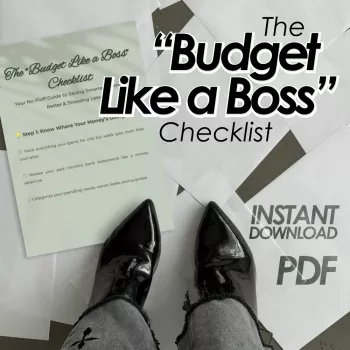
If you want a guided, plug-in-and-go format, you can start here: Budget Like a Beginner, Save Like a Pro: The Simple Path to Financial Peace (Digital Download).
How to use it in 30 minutes: a quick-start routine
You don’t need a “fresh month” or a perfect spreadsheet. You need a fast setup you can actually repeat.
- Minute 1–10: Write down income (after taxes) and the next four weeks of required bills
- Minute 11–20: Pick 3–5 spending categories that cause the most stress (food, gas, online shopping, takeout, etc.) and set simple caps
- Minute 21–25: Choose one savings target (emergency fund or one sinking fund) and set an automatic transfer for payday
- Minute 26–30: Schedule two recurring check-ins: a 10-minute weekly check and a 20-minute month-end review
- Use the guide’s prompts to decide what to change first when the budget feels tight: cut friction before cutting joy
Beginner mistakes this guide helps prevent
Most budget “failures” are really design problems. If your budget relies on willpower, it won’t survive stress. We built this to protect you from the most common traps.
- Starting with strict rules instead of building consistency (consistency wins first)
- Forgetting irregular expenses and then calling the budget a “failure”
- Trying to save only “what’s left” instead of saving first—even a small amount
- Using too many categories, which increases fatigue and makes quitting more likely
- Ignoring cash flow timing (paydays vs. due dates) and accidentally overdrawing
- All-or-nothing thinking: one slip doesn’t mean the month is ruined
Pair it with stress-reducing habits (budgeting works better when the body is calm)
If you want a structured way to downshift before money tasks, our team also offers: Muscle Relaxation Toolkit for Total Tension Relief – 3-in-1 Bundle for Deep Muscle Relaxation.
Two reliable resources you can keep in your back pocket
- Consumer Financial Protection Bureau (CFPB) — Budgeting resources
- FDIC — Money Smart (financial education)
FAQ
How do beginners start budgeting if money is already tight?
Start with a minimum budget: list essentials and due dates first so you prevent overdrafts and late fees. Then add one small automated savings transfer on payday and one clear cap in a problem category so you build consistency without feeling boxed in.
What’s the simplest way to save money without tracking every purchase?
Set spending caps for 3–5 categories that tend to run high, automate savings on payday, and do a 10-minute weekly check-in to adjust before overspending stacks up. This creates guardrails without requiring you to log every transaction.
Is this digital download useful if income varies each month?
Yes—variable income works well with a baseline minimum budget that prioritizes essentials first. With weekly updates and a buffer for irregular expenses, you can plan around cash-flow timing instead of guessing what will be “left over.”















Leave a comment